
Review and Revive, Part Two
By: Sandra Burgess
We are ten weeks into the school year, and I am actually enjoying my Wednesday game days. No one is more surprised to read that sentence than me!
I am embracing the miniscule amount of mayhem I’ve allowed into my orderly classroom. My current fifth graders are loving life; my former fifth graders pass by the room and ask, “Why didn’t we ever do that?”
My answer is always, “When you know better, you do better. And I apologize!”
I am ready to share a couple more of my favorite games. I hope you will give these a try!
Spelling Relay
This one was a solid 7 on the chaos scale. The fun factor is high, so I didn’t mind it!
Materials here were simple.
- Two small whiteboards, the small kind that students use at their desks
- Two dry erase markers
- Two erasers…I use the fancy kind (Kleenex)
I love a game that requires very little set up and expense!
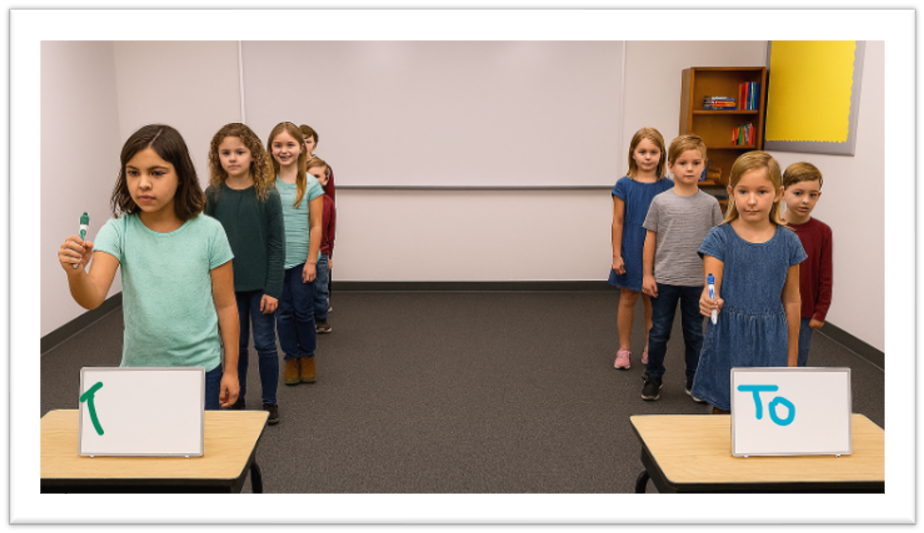
Students are split up into two teams. If you have a very large class, you could do more teams, but two teams worked great for my 12 students.
I lined the teams up in the back of the classroom in two lines. I established a ‘starting line’ for the first student to stand behind.
In the front of the room, I placed two desks near the wall with a small whiteboard on each desk.
I gave a dry erase marker to the first student in each line, then placed myself squarely in the ‘danger zone’ between the two desks in the front!
I then gave the rules!
The Rules:
- The teacher will say a spelling word.
- The first student will run to his team’s small board and write the first letter of that word on the board.
- That student will then run back to his team’s line and pass the marker to the next student. That student may not leave the starting line until he has the marker in his hand! The first student returns to the back of his team’s line.
- That student will run to the board and add the next letter of the word, return to his team’s line, pass the marker.
- The game continues in the same manner until a team member believes he has finished the word correctly. That student, while still standing at his board will yell “Check!”
- All activity ceases while the teacher looks at the word and declares that it is correct! (the team gets a point) …. or incorrect! (the game continues)
**Note: If a student reaches the board and notices that a previous team member has made an error, he may use his turn to correct a letter instead of adding a letter. But he may not do both on one turn. THIS is why the teacher should be right next to the boards!
** Another note: Students must go in order. No student may skip his turn.
What I like about this game:
- There is a good deal of thinking going on here! The students learn quickly that they need to take a second to look at what their previous teammates have written in case a student has made an error that needs to be corrected.
- A student who is unsure is usually not ‘called out’ or even noticed for their mistakes. In the chaos, everyone understands that the last student may have written the last letter OR NOT. They may have made a correction. So, the fact that the work is taking place away from the prying eyes of the overly righteous and judgmental student in the room is a win!
- There is so much comradery! It is a different type of teamwork. They aren’t all working at the same time, but they are all working toward the same goal. There is high-fiving. There is fist-bumping! Everyone is in it to win it!
Tips:
- Ground rules are helpful. Examples I have for you after the first round: No one may throw the marker. No one need to slide into homebase (the starting line) to pass the marker. You know…things you don’t think you have to say!
- If you have used all of your spelling words and there is a tie, find the most challenging word your class has come across in any subject recently for the tie breaker! Maybe Byzantine (fourth grade Middle Ages history) or Deoxyribonucleic (sixth grade life science). Trust me, that is a fun round!
Sink or Swim
This is a game that does have the potential to breed a little animosity. However, I find that this is a teaching opportunity for that exact problem.
For this game, the supplies are…well, really…nothing! The teacher just needs a list of the questions being reviewed.
For scorekeeping, there is also nothing required.
I know you like this game already!
In sink or swim, teams will be at their desks. You do need a way to tell who is on which team. I find the most effective (and least confusing) way to do this is just have one team sitting in the desks on one side of the room; the other team sitting in the desks on the opposite side of the room.
You can decide to go straight down the rows for questions or randomly choose (popsicle sticks or an app) students. That important decision, I leave up to you! I tend to just go down the rows, but there are probably more exciting ways!

The Rules:
- All members of all teams will stand. When standing, students are “swimming”
- The first question will be asked to the first student.
- If the student answers correctly, she chooses a student on the other team to sit. When students are sitting, they have “sunk”. Sunk students do not get a turn.
- If the student answers incorrectly, she will have to sit. She is now sunk.
- The game continues back and forth between the teams.
- After the first few turns, people will be sitting on both teams. At any point that a student answers a question correctly, she has the option to revive one of her sunk classmates to the state of swimming. If she chooses that option, she may not sink someone on the other team on that turn.
- The game continues until one team is entirely sunk. The team with one or more swimmers remaining is victorious!
What I like about this game:
- It. Is. Calm. Calmness is my love language!
- I like when a student who struggles is sunk by the other team. I know that sounded mean, but I think the assumption is always that the other team is sinking the ‘smart kids’ so that they cannot answer the questions. I have seen a little glimmer of self-esteem pop in a child’s eyes when someone thinks they are ‘a threat’. It is lovely!
- This game can be used for so many different things! Math facts; history reviews; filling in analogies; vocabulary review; parts of speech. The possibilities are endless.
- While some kids start to feel ‘targeted’, it is a great teaching opportunity. We often have the ‘this is just a game and it is supposed to be fun’ conversation. And once we are all in the right mindset, it honestly just becomes funny when a student is sunk and saved over and over and over again.
- Students are solely responsible for their questions. There is no safety net, and they know it! They tend to show up to game day a little more prepared!
Tips:
- I make it clear that this game is not a game in which team mates help each other. Therefore, this is a silent game in my room.
- If a student is talking, I immediately sink that person. If they are already sitting, I sink one of their teammates. That stops the chatting fairly quickly!
- On occasion, I will make a rule that no one can sink the last person on a team, meaning that the team can only lose when the last person misses a question. This is only a good idea if you have plenty of time to play! If I am short on time, I do not implement that rule.
These are two of the easiest games in my arsenal, and both seem to be crowd favorites.
Try some games if you are looking for a way to review your content that engages your students…all of your students. I think you will find that it is worth the trouble, and yes, even a little minor chaos.